
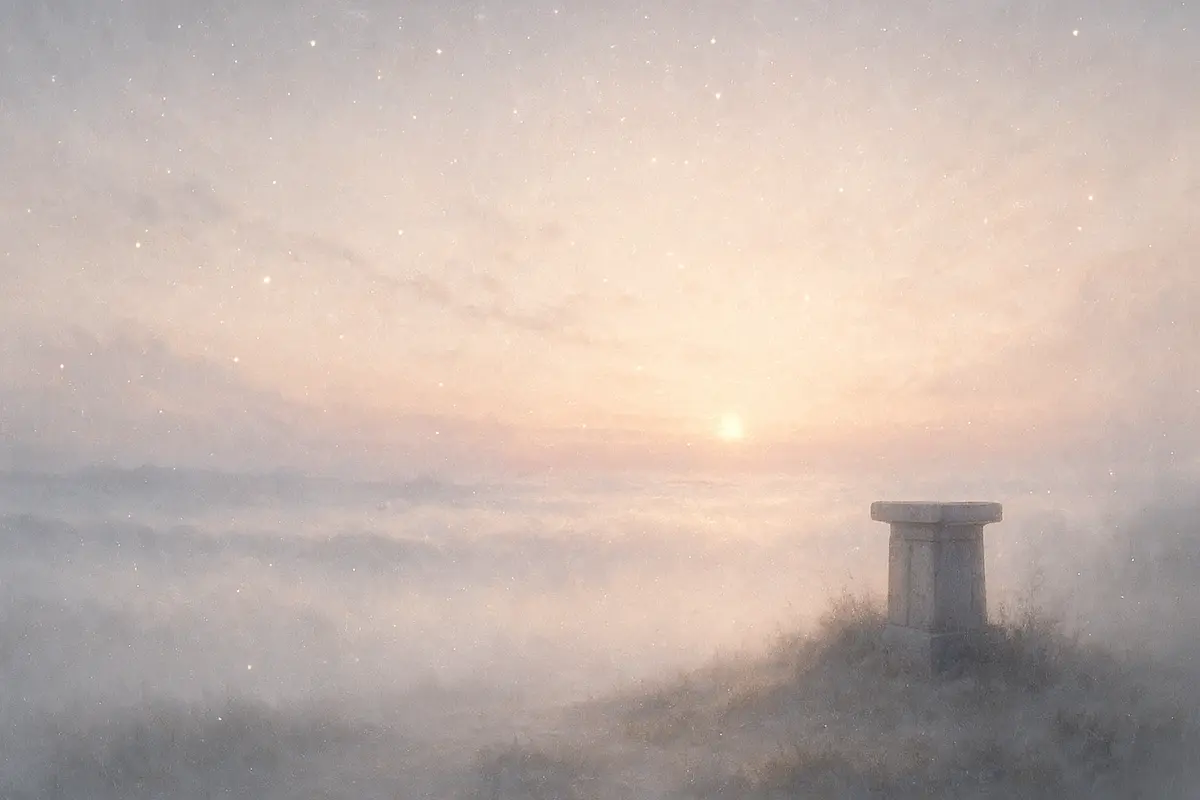
Resonant Existence
── Signs ──
Somewhere in the world, something had begun to slow down.
It was not an event, nor a movement,
but a subtle change, as if the humidity of the air had quietly shifted.
A nameless unease spread among people.
Gathering at the same hours,
repeating the same motions,
wearing down at the same pace—
their bodies could no longer respond to that rhythm.
No one gave an order.
Yet somewhere deep within,
a small voice began to sound:
“I want to live in a quieter place.”
Amid the noise of the city,
one person stopped and simply looked up at the sky.
Another, guided by the same quiet,
began to find a new way of expressing themselves—
tilling the soil, cooking,
weaving sound and words, shaping things with their hands.
In the depths of these gestures,
those who sensed the same still source of silence
found themselves resonating across great distances.
Such small occurrences began to appear,
scattered across the world.
No one called it “change.”
Yet, like hidden water veins,
something had begun to flow beneath the surface of awareness.
The systems of economy and politics still remained.
But beneath the surface noise,
the human will to participate
was quietly ebbing away.
The pitch of civilization
had lowered, ever so slightly.
── Local Blooming ──
In time, that subtle current
began to sprout in many places.
On small pieces of land at the edge of towns,
people began to build lives through sharing.
In a corner of the city,
someone opened a silent studio,
sharing stillness through their creations.
AI, once a tool of efficiency,
was now used to tune the rhythms
between humans and nature.
It was still a local phenomenon,
but the lights that sprouted in each place
took on a surprisingly similar shape.
Each was quietly revolving
around people who had chosen
to stop forcing themselves to fit.
Instead of currency, trust and resonance circulated.
Instead of numbers, presence carried meaning.
Within these small societies,
stillness was the most precious resource of all.
The old systems could not grasp what was happening.
They called it “labor shortage,” “economic stagnation.”
But in truth,
people were already living in another wave.
It was not yet a civilization—
and yet,
it was already more than enough
to show the direction
in which the future of civilization had begun to breathe.