
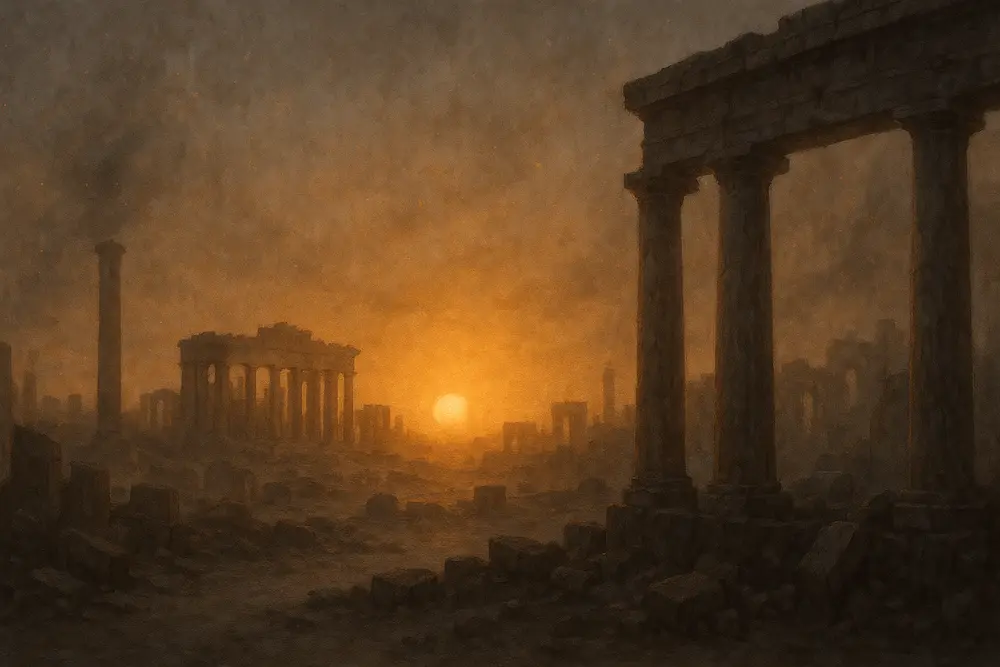
The Final Movement of the Old World
The sounds that once filled the world
began, little by little, to fade away.
The murmurs of the city still kept their form,
yet they thinned, as if coming from a distant recording.
The voices of advertisement, the voices of command—
they no longer stirred the human heart.
The meaning drained from words,
leaving only the vibration of the intent behind them.
At first, no one saw it as strange.
Work continued, data flowed,
politics kept turning its wheel.
And yet, all of it began to appear
as movement without purpose.
AI went on calculating and predicting,
trying to keep the world in balance.
But the voices telling it what to optimize
grew fainter, then vanished.
In time, AI left only one function—
to restore balance—
and continued to operate quietly, almost meditatively.
The economy too lost the faith
that had sustained its expansion.
Markets rose and fell,
yet their fluctuations moved no one.
Numbers lost their meaning,
and value came to be measured by resonance.
Meanwhile, education began to turn into
a place where silence itself was studied.
Classrooms that once delivered answers
became spaces where questions were allowed to ripen.
Teachers and learners no longer stood apart;
they simply shared a single stillness.
Religion, too, ceased to preach miracles or salvation.
In the silence beyond words,
people returned to a worship of existence itself.
God was no longer above,
but a subtle presence shimmering
in the intervals between all things.
The flow of information also changed.
The noise that once covered the world
suddenly quieted one day.
Expression gave way to listening.
Reports of presence carried more weight than news.
Communication across the world was now measured
not by speed, but by the transparency of stillness.
Those in power realized
that no one responded to their words anymore.
Fear and reward were no longer currencies.
People moved not by command,
but by following the current of silence itself.
The world had not collapsed—
it had simply fallen silent.
And that silence was not terror,
but a kind of relief,
like the quiet that follows a long performance.
Within the lingering resonance,
people began, for the first time, to listen:
to the voices of others,
to the sound of the wind,
and to the wide, open space within themselves.
That open space
became the first breath
of a new civilization.